About us
About us
Exhibition
Exhibition
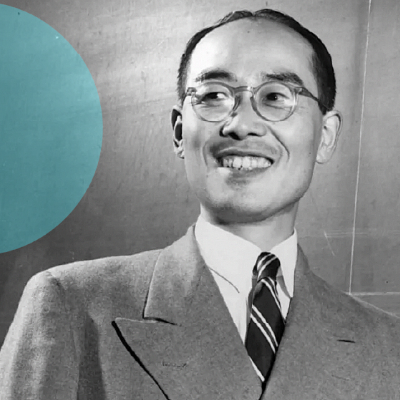
Hideki Yukawa (1907–1981) was born in Tokyo. As quantum mechanics took shape in Europe during the 1920s, Yukawa gradually established his interests and direction in theoretical physics. In 1935, he proposed the meson theory, predicting the existence of an intermediate particle within the atomic nucleus to explain the strong interaction between protons and neutrons (nucleons). Since protons carry positive electric charge and should repel each other through electromagnetic force, there had to be a powerful yet short-range force capable of tightly binding nucleons inside the nucleus. Yukawa hypothesized that this “nuclear force” arose through the exchange of a new particle, and he calculated its mass to be approximately 200 times that of an electron—this was the meson.
In 1947, the π-meson was discovered in cosmic rays, providing experimental confirmation of Yukawa’s theory. In 1949, he was awarded the Nobel Prize in Physics for this groundbreaking work, becoming the first Japanese physicist to receive the honor and laying a foundational cornerstone for the development of modern particle physics.
Furthermore, the “Yukawa interaction term” in the Standard Model of particle physics plays a crucial role in explaining how fermions acquire mass. In other words, without this theoretical framework, the origin of mass itself would remain fundamentally unexplained. Yukawa also founded the journal Progress of Theoretical Physics, nurturing a new generation of Japanese physicists and helping reestablish Japan’s presence in the international scientific community after World War II.
Born into a family of deep scholarly traditions, Yukawa received a rigorous education in classical Chinese learning from an early age. Even before entering school, his maternal grandfather taught him to recite The Great Learning, The Analects, and Mencius. The children’s magazines prepared by his mother, along with the Laozi, Zhuangzi, and translated works of world literature in his father’s study, all became vital sources of intellectual nourishment. These influences fostered in him a rare character that harmonized scientific rationality with humanistic spirit.
This exhibition presents 28 calligraphy works, manuscripts, and paintings by Hideki Yukawa, his family members, and close associates, generously donated by Professor Masao Tanigawa. Through these selected works, the exhibition reveals the humanistic depth of this great physicist.
The exhibition is organized into three thematic sections.
“Family Heritage and Kindred Scholars”, features works by Yukawa’s family and friends, illustrating his inherited scholarly tradition and personal network.
“Yukawa as Poet-Scientist”, showcases his waka poetry and landscape paintings, which reflect how he contemplated nature, the universe, and life through brush and ink.
“Toward One World”, focuses on his postwar involvement in the peace movements, embodying the profound humanistic ideals and global responsibility he embraced as a nuclear physicist reflecting on the experiences of war.
In 1947, the π-meson was discovered in cosmic rays, providing experimental confirmation of Yukawa’s theory. In 1949, he was awarded the Nobel Prize in Physics for this groundbreaking work, becoming the first Japanese physicist to receive the honor and laying a foundational cornerstone for the development of modern particle physics.
Furthermore, the “Yukawa interaction term” in the Standard Model of particle physics plays a crucial role in explaining how fermions acquire mass. In other words, without this theoretical framework, the origin of mass itself would remain fundamentally unexplained. Yukawa also founded the journal Progress of Theoretical Physics, nurturing a new generation of Japanese physicists and helping reestablish Japan’s presence in the international scientific community after World War II.
Born into a family of deep scholarly traditions, Yukawa received a rigorous education in classical Chinese learning from an early age. Even before entering school, his maternal grandfather taught him to recite The Great Learning, The Analects, and Mencius. The children’s magazines prepared by his mother, along with the Laozi, Zhuangzi, and translated works of world literature in his father’s study, all became vital sources of intellectual nourishment. These influences fostered in him a rare character that harmonized scientific rationality with humanistic spirit.
This exhibition presents 28 calligraphy works, manuscripts, and paintings by Hideki Yukawa, his family members, and close associates, generously donated by Professor Masao Tanigawa. Through these selected works, the exhibition reveals the humanistic depth of this great physicist.
The exhibition is organized into three thematic sections.
“Family Heritage and Kindred Scholars”, features works by Yukawa’s family and friends, illustrating his inherited scholarly tradition and personal network.
“Yukawa as Poet-Scientist”, showcases his waka poetry and landscape paintings, which reflect how he contemplated nature, the universe, and life through brush and ink.
“Toward One World”, focuses on his postwar involvement in the peace movements, embodying the profound humanistic ideals and global responsibility he embraced as a nuclear physicist reflecting on the experiences of war.